Apple Podcasts
  Spotify
  Pandora
  Podchaser
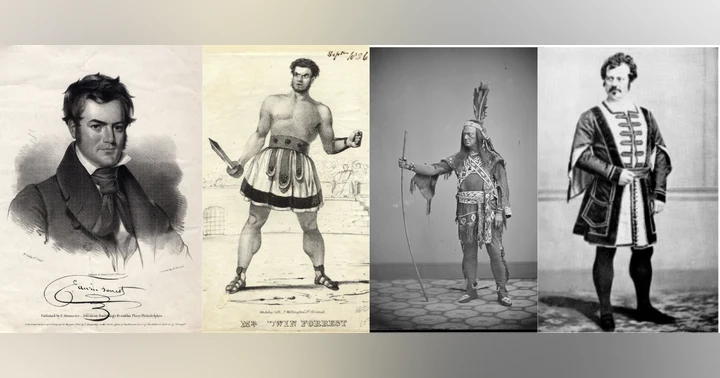
 The second installment of the story of Philadelphia's own Edwin Forrest. We cover the period from 1829 to 1839, when he was building the repertoire of roles that would shape his career: Metamora, Spartacus, Jack Cade - and, surprisingly, Cardinal Richelieu.


The second installment of the story of Philadelphia's own Edwin Forrest, the first great star of the American Stage! In this episode we cover the period from 1829 to 1839, when he was building the repertoire of roles that would shape his career: Metamora, Spartacus, Jack Cade - and, surprisingly, Cardinal Richelieu.
To view a blog post and bibliography about today's episode, go to:
www.aithpodcast.com/blog/forrest-of-philadelphia-part-two-blog/Support the Show.
© Podcast text copyright, Peter Schmitz. All rights reserved.
℗ All voice recordings copyright Peter Schmitz.
℗ All original music and compositions within the episodes copyright Christopher Mark Colucci. Used by permission.
© Podcast text copyright Peter Schmitz. All rights reserved.
© Podcast text copyright Peter Schmitz. All rights reserved.
Hello, everyone. Welcome to the second part of our story about Edwin Forrest, perhaps the most well-known stage actor to ever come out of the city of Philadelphia.
In the last episode, we detailed his early years, starting from his childhood, through his struggles to break into the acting world in his teens, his journey to the American West, and his return home in triumph. And we told the story about how Forrest, by the age of 21, achieved theatrical stardom and financial success.
So what’s left? Quite a lot, because we’ve only just reached the first few chapters of most standard biographies of Edwin Forrest’s life. He lived 45 more years, after all. He performed on American and British stages thousands of times, in dozens of leading roles. He would be a central figure in one of the most famous urban upheavals, the Astor Place Riots of 1849, and he was at the middle of the greatest celebrity divorce trial of the 19th Century, perhaps of all time.
But as the focus of this podcast is Philadelphia theater history, we are going to narrow down the story by sticking to the parts of his life and career that pertain to Philadelphia. In this episode we will discuss Forrest’s sponsorship of an annual playwriting contest, how it built his standard repertoire, and how it fit into the literary and theatrical life of Philadelphia in the 1820s, 30s and 40s.
We left Forrest during his first blush of success. Both in New York and Philadelphia he was now a genuine star, and could command his own fate. Soon he was demanding, and receiving, a guaranteed $200 per show, as well as 50% of the gross box office receipts. Wherever he went, that was his standard contract. Theater managers didn’t like it, but no one knew how to refuse him, because his presence on the bill could almost guarantee a full house.
And they needed full houses, desperately. Philadelphia’s own theatrical scene at this point was in a confused, disrupted, and financially perilous state – one that it would not escape for almost 20 years. Three theaters, the Walnut Street Theatre, the Chestnut Street Theatre, and the newcomer the Arch Street Theatre - a few blocks away from each other and each located, unsurprisingly, on their namesake streets - would vie for audiences throughout this period, playing a never ending game of Beggar Your Neighbor.
If one theater had a star name or big attraction, the other two would do anything to poach their audiences away, even if it bankrupted them - and often, it did just that. Theater managers would cycle madly through each house, often lasting for only part of a season before moving on to another one.
Warren and Wood, the former leaders of the Philadelphia scene, were among these managers, but were eventually reduced to becoming stock company members once again, gratefully accepting charity benefit performances staged to keep them from penury. Philadelphia’s regular corps of resident actors were seldom paid, or at least infrequently paid, as managers were forced to guarantee visiting stars a huge portion of the box office. And worst of all, the city’s theaters had lost their primacy in America. Though Philadelphia retained a respectable cultural stature in the American theater world, from now on, no other American city could really compete with New York.
It’s not that exciting plays stopped being produced in Philadelphia, not at all. If you read through the numerous histories and memoirs of the period, they are full of accounts of plays and actors and lively anecdotes. Audiences flocked to see many plays, and stayed away from many others. Great actors came through town: Charles Kean, Fanny Kemble, Charles Matthews, Madame Vestris. Some were lauded, some were scorned. Some new young American performers began to make their own reputations. Circuses, variety acts, operas, ballets, melodramas, hippodramas - all could be seen regularly. Philadelphians, like all Americans, continued to expect and to receive theatrical entertainment. And, just as they had always done, Philadelphia’s clergymen even kept denouncing the Wickedness of the Stage - Edwin Forrest’s own mother and sisters found themselves compelled to listen to a sermon at Grace Church, as they sat in a pew that Edwin had paid for - a sermon which denounced the wickedness of the stage and all actors.
Other changes were coming, however. Industrial development boomed in the city, and immigrants flocked there to man the factories and the workshops. It was a fractious and contentious era, politically and socially. Riots and civil disturbances were increasingly common, Pennsylvania Hall, that “temple of free discussion,” would be burned down by the Anti-abolition Riots in 1838, and in 1844 the Nativist Riots caused militia troops to engage in all-out warfare in the streets with anti-Catholic mobs.
Through all this, however, Edwin Forrest continued to make Philadelphia his base of operations. From 1827 through 1836 he shared a home with his mother and sisters, on North 10th St., continually lavishing it with new furnishings and silverware. He toured throughout the country, playing to mostly packed houses wherever he went. He was the family’s main support, especially after March 4th 1834, when his brother William, who was then a co-manager of the Arch Street Theatre, died suddenly and painfully of a bowel obstruction, despite the best efforts of the eminent Philadelphia physician Dr. McClellan to save him. Edwin was unable to say goodbye to his brother, since he had left on a boat for New Orleans that very day.
As he traveled around the country, Edwin Forrest’s repertoire of roles were still largely Shakespearean and classical-style tragedies: Othello, Macbeth, Lear, Richard III, Hamlet. A favorite role was Damon in Damon and Pythias - the story of two friends so devoted that they would gladly volunteer to die in the other’s place. He also liked doing William Tell and Virginius, by the English writer and actor Sheridan Knowles. Forrest could also do Iago in Shakespeare’s Othello, and indeed many times switched off the roles of Iago and Othello with other actors during a run, including Thomas Cooper, who once had advised the fourteen year-old Forrest to learn his craft and not fixate on stardom. Now Cooper, nearing the end of his long career, was happy to hitch his fading name to Forrest’s rising one. Forrest could fill New York’s enormous Bowery Theatre, after all, with his huge fan base, he was a Hot Property, as we would say today.
And, like all leading men of his day, Edwin Forrest was looking to expand his repertoire. Because the standard practice of the day was not to develop each play slowly as an ensemble, as we do today, but for actors to arrive at a theater with their portfolio of roles at easy command. A stock company of actors would fill in the supporting company. Actors usually supplied their own costumes, and the theater managers would arrange for scenery and musicians. Except for the very newest plays, one or two rehearsals was all that was considered necessary.
Forrest was looking for new tragedies. Comedy, remember, was not his brand. He was a tragedian, and in keeping with his political and philosophical temperament, he preferred plays that had stories about brave and muscular male characters standing up to invaders and tyrants. Sure, there might be a minor love story in the plot somewhere, but he never played the lover himself. His preferred character type was a mature man with intensely loyal male friendships, who was defending his wife, his children, and his country.
Just as rigorously as he continued to train and build his athletic body, he continued to study and to expand his craft. As one of the first native-born American actors to ever achieve prominence, he soon felt a responsibility to encourage American drama. He was a Jacksonian Democrat, through and through, and like many other Americans of his day, he felt strongly that fifty years after the American Revolution it was time to end the dominance of British high culture in many areas of American life - including the theater. Forrest was already regularly performing in two plays, Brutus and also Therese, by the American actor and author John Howard Payne, but Payne’s work had already been widely produced by British theaters and British actors. Forrest wanted something that would be identified with him alone.
An avid and voracious reader, Forrest discovered that the Washington Irving novel The Last of the Mohicans and also the Mordecai Noah play entitled She Would Be a Soldier were thrilling stories, and that, importantly, their depiction of American Indians (“Native Americans,” as we would say today, but “American Indians” back then) reminded him of his youthful sojourn in the Louisiana backwoods with his Choctaw companion Pushmataha. He saw the possibility of the “aboriginal character” as a vigorous and physical characterization, with a free spirit and a defiant independence.
In 1829 Forrest issued a public invitation for American writers to submit plays to a contest that he would sponsor for a five hundred dollar prize - with the stipulation that the principal character be “an aboriginal of this country.” The winner of the contest was John Augustus Stone, an actor from Massachusetts who dramatized the story of King Philip's War, the bloody conflict between the Puritans settlers and the Native Americans from the late 17th Century in Massachusetts. It was called Metamora, or the Last of the Wampanoags.
Now, Stone had acted with Forrest, including productions of She Would Be a Soldier, so he knew exactly how the leading character should be written to win the star’s attention: A natural man, with a free spirit and a beautiful body, one who sleeps amidst the roar of the waterfall, and wakes to defend both his family and his land. Oh, there was a subplot involving a young white Puritan woman improbably named “Oceana” who is pursued by a villain named “Fitzarnold,” but most of the action involves Metamora - rescuing Oceana from a wolf, defending his village against the invading whites, declaring all out war, finding his young son dead after being defeated in the battle, and finally killing his own wife Nahmeokee rather than have her become a victim of the white man’s predation.
At the end, Metamora was gunned down, and he fell next to the body of his wife and child as the curtain descended. Forrest himself worked closely with Stone on revising and shaping the piece to show off all all his strengths as an actor, including a famous speech in which Metamora defies and curses his White oppressors:
White man, beware! The mighty spirits of the Wampanoag race are hovering o’er our heads; they stretch out their shadowy arms to me and ask for vengeance; they shall have it. The wrath of the wronged Indian shall fall upon you like a cataract that dashes the uprooted oak down the mighty chasms. The war whoop shall start you from your dreams at night and the red hatchet gleam in the blaze of your burning dwellings! . . till the lands you have stolen groan under your feet no more!
Everyone who ever saw the piece recalled that Forrest’s entire body transformed to play the character, everyone who ever saw the piece recalled. He became lithe, self-contained, full of supple energy and mystery. The vituperative speech brought down the house, every time, as he threw a hatchet into the ground and stalked off the stage.
Metamora debuted at the Park Theatre in New York City on December 15, 1829 to wild acclaim. Its success was everything Forrest had hoped for. Stone received the prize money and the receipts of the third night . . . and then after that the play became Forrest’s exclusive property. It would remain in his repertoire for the next 35 years.
On January 22, 1830 he brought it to the Arch Street Theatre in Philadelphia, and the reception was similarly overwhelming. During Forrest’s lifetime, in fact, it was a rare year that the play was not performed at least once in Philadelphia. Many times, both there and elsewhere, he would make sure that delegations of actual Native Americans were in the audience, and supposedly their whoops were sometimes added to those of the actor’s onstage, although more often than not they just kept their thoughts about the play to themselves. Despite its fierce main character and its denunciation of White invasion, more lately many scholars have pointed out such “stage Indian” portrayals such Metamora actually helped white audiences psychologically to ease the way for the removal of Native Americans from their lands in the East, and then the West, too. Most Americans were content to see Metamora as a hero of a bygone day, and did not trouble themselves about their own rights to the land they currently inhabited. The Indian Way of Life was doomed - so very sad, wasn’t it? But it made such a great play!
The success of his first playwriting contest inspired Edwin Forrest to form a committee of eminent literary men as judges, and to make it a regular event. Forrest read hundreds of plays personally, looking for another text that could also be a successful hit for him - though he dropped the stipulation that it be about “Aboriginal Americans.” The winners of the contests were always male, primarily wrote plays on classical subjects in Shakespearean-style verse, and they were always Philadelphians. Though all this may call into question whether the playwriting “contest” was really much of a contest, it did seem that Philadelphia was finally developing its own dramatic literary scene. John Augustus Stone even moved to Philadelphia and won the contest again in 1833 with a play entitled The Ancient Briton, though this play failed in its sole performance at the Arch Street Theatre and was never repeated. Beset by money worries and personal problems, Stone fell into a deep depression the following year, and committed suicide by jumping into the Schuylkill River. Forrest paid for his funeral and a memorial headstone at a Philadelphia cemetery.
A similar lack of success met the 1830 winner, Richard Penn Smith, the son of the Provost of the University of Pennsylvania, for his play Caius Marius set in Republican Rome. Nor was any production ever staged for the next winner: Pelopidas, or, the Fall of the Polemarchs, about the liberation of Ancient Thebes from the oppressive Spartans. It was by another Penn graduate, a young physician named Robert Montgomery Bird.
Bird was to be a significant figure in Forrest’s life. Robert Montgomery Bird was born in Delaware in 1806, but his family moved to Philadelphia when he was four, after the death of his father. He graduated from Germantown Academy and the University of Pennsylvania. Trained to become a physician, he quickly gave up practicing medicine and was instead determined to have a literary career. He set out a careful plan: He wanted to write multiple biographies, novels, and plays - comedies, melodramas, and tragedies.
After his first play Pelopidas won Forrest’s contest, he became close friends with the actor, and Bird quickly sent him another. Entitled The Gladiator, it was about the slave rebellion led by Spartacus during the late days of the Roman Republic. Forrest loved it, and proposed that they work on it more together. Bird and Forrest would do so as they traveled together throughout the United States, stopping often on their journeys to view Niagara Falls, which was one of Forrest’s favorite natural wonders.
In the version they finally came up with, the play perfectly suited Forrest's public image as a performer: Strong, independent, and defiant - educated, but with a decided populist and appeal to the white working class. After all, was his story not their story? Wrote an admiring editor in the Dayton, Ohio Journal: “His success is indeed an incentive to the young men of this country who are struggling with adverse circumstances - and is typical of our free, go-ahead and ‘universal Yankee nation’.”
Despite Forrest's famous political support of Democratic President Andrew Jackson and for American territorial expansionism, in The Gladiator there is in fact a surprising critique of American Imperial Ambition and Manifest Destiny. In it we find this passage, when Spartacus, the rebellious slave from Thrace, first sees the magnificent city of Rome. His friend Bracchius asks him: "And what thinkest thou, now thou hast seen it?" Replies Spartacus:
That—if Romans had not been fiends, Rome had never been great! Whence came this greatness, but from the miseries of subjugated nations? . . . There is not a palace upon these hills that cost not the lives of a thousand innocent men; there is no deed of greatness ye can boast, but it was achieved upon the ruin of a nation; there is no joy you can feel, but its ingredients are blood and tears.
But the clearest theme in the play was the struggle of the Common Man against Tyranny. This was exactly what Forrest was looking for, and he made sure it was highlighted. He knew his audiences, after all. When the play was first staged in September of 1831, the reception at the New York’s Park Theatre was again enthusiastic. In the climactic scene at the end of Act Two, which takes place in the gladiatorial arena, Spartacus is told by the aristocrat Crassus that if he kills his next opponent, he and his family will be freed. But his next opponent, it turns out, is his long-lost brother, Pharsarius! Instead of fighting, the two brothers instantly plot a rebellion.
Freedom for gladiators! Death to the Roman fiends, that make their mirth/ Out of the groans of bleeding misery!/ Ho, slaves, it is your hour to kill!/ Kill and spare not - for wrath, and liberty!/ Freedom for bondmen - freedom and revenge!
There are shouts and trumpets, as the gladiators and their guards rush to fight each other. Forrest, as Spartacus, would strip to the waist, draw his sword, and pose downstage center! His muscled torso gleamed in the light, and his mighty legs stood like two huge pillars. The curtain fell and the audience invariably roared its approval.
Now I know what you are thinking: Did nobody see the parallels between the call to liberate ancient Roman slaves and the necessity to end the American institution of chattel slavery? Did Bird and Forrest really have to go all the way back to Ancient Rome for examples of tyranny and despotism and the fight for liberty? You feel like saying: If you’re looking for slave rebellions, fellas, you don’t have to go far. What about Nat Turner, or Toussaint l’Overture? Well, suffice it to say that, like almost all White Americans of their day, no they did not make that connection at all. Their conceptions of the struggle for Liberty against Tyranny pretty much began and ended with White men. Although Forrest for his entire life rejected the company and politics of the social elite in America, he never made common cause with the situation of Black people in his country. He would have been appalled even at the suggestion, frankly.
Well, The Gladiator, along with Metamora, would become the backbone of his standard repertoire. Later he would also add to this repertoire the play Jack Cade, based on the revolt of English peasants in the 15th Century, which is also portrayed in Shakespeare’s play Henry VI, part 2. Although the play Jack Cade had actually been written for a rival actor by yet another Philadelphian, Robert T. Conrad, when that actor failed in it, Forrest snapped the script up and made it his own. In Jack Cade, again, he played a strong and independent rebel against aristocrats, who falls at the end of the play, but dies defiantly, fiercely defending his rights. Until our chains are molten in the glow/ Of kindled spirits; for I seek not power,/ I know no glory - save the godlike joy of making/ The bondman free.
Some people, at least, saw the problem. The poet Walt Whitman, reviewing The Gladiator in his newspaper The Brooklyn Eagle in 1846, saw that Forrest was tapping into a deep vein of American political emotion, but was missing a huge opportunity to give it direction - despite what was sitting right there if you took the lines of the play literally. “This play is as full of Abolitionism as an egg is of meat,” Whitman declared. But like most of Forrest’s plays, though it explicitly appealed to the American common man, it was not actually telling American stories. Indeed, except for Metamora, none of Forrest’s repertoire of plays took place in America, or had American characters in them! “Give us American plays too,” Whitman begged Forrest, “Matter fitted to American opinions and institutions.” This would do the republic service, and himself, too, in the long run.
But Forrest and his audiences were never to make that connection. In fact the only ones that seemed to see how his plays were relevant to current American politics was an audience in Augusta, Georgia, in 1831. White Georgians, many currently engaged in dispossessing and banishing their Cherokee neighbors from the state, were indignant at his performance of Metamora’s roaring assertions of Indian Rights. The Georgians rose with yells of scorn and indignation against Forrest from the audience. A local judge declared in the newspaper: “Any actor who could utter such scathing language, with such vehemence, must have the whole matter at heart . . . Forrest believed in that damned Indian speech, and it is an insult to the whole community!”
The next night, no one showed up to the theater in Augusta to see Edwin Forrest, and the rest of the run was canceled.
But on the whole that was a rare failure to please the crowd for Edwin Forrest. Those plays, Metamora, The Gladiator, and Jack Cade, along with the rest of his repertoire, were performed in almost every city in America, from California to Maine. They were performed over and over again at Philadelphia’s theaters - almost every year he would bring them for a run of several weeks at the Walnut, the Chestnut, or the Arch. Jack Cade was especially popular in Philadelphia, and that play comprised one quarter of his total appearances between 1841 and 1856. It is estimated that he earned the majority of his money, over the course of his entire lifetime from the three plays he had commissioned in his contest. But, remember, after paying the initial prize money of one thousand dollars, he considered his financial obligation to them over. He owned the play.
Although Robert Montgomery Bird provided him with two more scripts, Ollaroosa and The Broker of Bogota (both set in America, finally - but in South America), they were not as lucrative and were rarely performed. Certainly they were not lucrative for Bird, who felt that Forrest had promised him even further royalties, and the two men had a falling out and never spoke again.
Forrest never even published the texts, and tightly held the scripts in his own control. When U.S. Copyright Law over plays was finally established, he registered them in his own name. They were his plays, after all, weren’t they? He paid for them, he made them famous, he felt. And indeed they never were to have much of a theatrical life after he was done with them. Though by all accounts they were absolutely thrilling theatrical experiences in their day, looking at the texts now . . . they seem like stodgy relics of a bygone era, their language mannered and stilted, their plots unperformable. Although Edwin Forrest had hoped to spark and inspire a revival of American dramatic literature, springing from his home city of Philadelphia, his prize-winning plays were to prove a dead end, in literary terms.
As it turned out, it was to be not a gentleman of Philadelphia, but a lady in Brunswick, Maine, Harriet Beecher Stowe, who was finally to write directly about the themes of slavery and injustice in America, and to bring them to life. Unauthorized stage adaptations of her 1852 anti-slavery novel, Uncle Tom’s Cabin, would have literally hundreds of productions in the years leading up to the Civil War on American stages. That novel, and those plays, did more to move people’s hearts, and actually Make the Bondman Free, than Forrest’s plays ever would.
________________________
So you’ll notice that there’s a bit of change to sound quality at this point. That’s because the final section of this episode has been added five years after the original release of “Forrest of Philadelphia Part Two” in August of 2021.
In August of 2026, as I record this as part of my ongoing efforts to re-think, re-score, and improve some of the earliest episodes of the podcast, I decided to add a story I left out of the original episode, because . . well because I hadn’t written it yet. This is an excerpt from my 2024 book, Adventures in Theater History: Philadelphia, which covers an aspect of the peak years of Edwin Forrest’s career that is seldom mentioned in popular histories about him. I didn’t have this information ready when I first created this episode, but I’m so happy to share it with you now. Here we go . . .
The last five nights of September 1839 Edwin Forrest performed the role of Cardinal Richelieu in Edward Bulwer-Lytton’s verse drama Richelieu, or the Conspiracy. The venue was the former Walnut Street Theatre in Philadelphia, whose current manager, Francis Wemyss, had renamed it “The American Theatre” to emphasize that unlike his rival managers in the city, he patriotically featured native-born actors like Forrest.
At the age of 33, the actor was at the peak of his powers. Richelieu was to become — in artistic terms — the greatest role of his career. Forrest had first attempted it, earlier that same month, in New York City at the National Theatre. Up to that point in his career, the actor had been known chiefly for his muscular physique, his powerful voice, and his imposing physical presence on stage. This well suited him in the famous roles from 19th-century plays that were at the core of his repertoire: Metamora, Spartacus, Jack Cade, and Virginius. But Richelieu was an old man, close to his own death, in the script. It was a shock for many in the audience to see Forrest using the force of his considerable intellect, to bring the dry humor of the Cardinal’s lines and the cunning of his crafty political machinations to the forefront. The famous English actor Charles Kean, who was in the audience, was reported to have turned to his wife Ellen Tree and said, “Ellen, this is the greatest acting we have ever seen or ever shall see.” (Which, coming from the son of Edmund Kean himself, was quite a statement.)
Bulwer-Lytton’s play (originally written for Forrest’s great rival, William Charles Macready) is completely absent from the modern theatrical repertoire, along with most 19th Century verse dramas. But in its day, Richelieu was deeply respected — the only play of Bulwer-Lytton’s to be performed more frequently was his wildly popular melodrama The Lady of Lyons. Nowadays he is mostly s for the opening sentence of his 1830 novel Paul Clifford (“It was a dark and stormy night”), but we should perhaps also note that the even more famous adage “The pen is mightier than the sword” first appeared in Bulwer-Lytton’s Richelieu.
In terms of box office, Richelieu was never Forrest’s most profitable of his extensive repertoire of tragic roles, but it was always to be his most highly praised. Part of the impact was due to the visual impact of his costumes for the Cardinal — the 19th-century audience did love to see lavish and “historically accurate” costumes. Forrest’s personal costumer, Andrew Jackson (“Dummy”) Allen had labored especially hard to produce sumptuous clothes for the whole company in the style of the era of King Louis XIII.
[Forrest] had evidently memorized the massive role in a hurry and was still — as actors say — “finding his way” in the role. But by all accounts, Forrest made a true connection with the audience as Richelieu. A New York correspondent, whose account was reprinted in the Philadelphia National Gazette, was in ecstasies when he first witnessed it:
It was as if the mighty statesman were before us . . . his indomitable grandeur and pride were portrayed to the life . . . In the fourth act, where Richelieu . . . . thunders his threats of excommunication against his successful rival and defies his power, was the climax of a piece of acting, which does honour to Mr. Forrest and to our stage.
Forrest was naturally pleased by such praise in the newspapers of his home city. He apparently was also especially gratified by the efforts of the Walnut’s manager, Francis Wemyss, who had spared no expense to provide the great actor with the finest and most historically accurate sets for Richelieu, in order to match the splendor of Allen’s costumes. (He had also performed that night, in the role of the Count de Berighen.)
Wemyss was called to Forrest’s dressing room after the show and found him in an excellent mood. The actor complimented the Philadelphia manager and offered him the opportunity to choose any show from his repertoire, as a personal benefit, later in the run. In his memoirs, Wemyss recalled the praise with pleasure, as well as the opportunity for additional income that Forrest gave him: “Such a proffer, on such an occasion, from such a man, was a feather in the cap of a manager, which no one has ever been able to pluck away from me.” But in monetary terms, of course, Forrest was the clear winner of the entire two-week engagement, netting almost $3,000 as his lion’s share of the box office receipts, while Wemyss received a mere $289 from that extra benefit night. . . .
After Forrest’s death in 1872, his longtime friend and admirer, the Philadelphia critic James Rees, had a different line from Richelieu in his mind when he thought of the proud actor in his final years: “ . . . My name is Richelieu — I defy thee!” In fact, Rees declared that there was no other actor that ever matched his performance in the role.
Although, of course, nowadays we may discount the opinions of Rees — and other rather slavish friends and biographers of Forrest — we also have the opinion of Francis Wemyss on the subject. He had seen all the great actors of the era in the part and felt that Forrest’s portrayal was superior:
“Of Mr. Forrest’s performance in this part I can scarcely find words of sufficient praise . . . Richelieu will never find a better representative. Macready and Vandenhoff both fall far below Forrest, by comparison.”
Coming from someone who had nearly gone bankrupt in his attempt to please Forrest, we can perhaps allow Wemyss’ estimation to be the final verdict. Certainly nothing would have pleased the actor more than to beat Macready at the end.
_____________________________
We will meet the actor and theater manager Francis Wemyss once again in Season Two, in our series of episodes about the scandalous play The Quaker City. Look for that, if you haven’t heard those already.
Well, that’s our episode for today. I’m Peter Schmitz, and our theme music was composed by Christopher Mark Colucci. Additional sound editing was done in August of 2026 by Peter Schmitz, and additional music and underscoring is courtesy of Epidemic Sound. The section “Edwin Forrest as Richelieu” is taken from my book, the compendium of stories entitled Adventures in Theater History: Philadelphia, published in 2024 by Brookline Books.
For extra information about that book as well as all the events we describe in this episode, please visit our website www.AITHpodcast.com. There is a blog post there with lots of images from the life of Edwin Forrest, more insights and explanations, and a bibliography of our sources for the episode. Thank you for coming along on another Adventure in Theater History, Philadelphia.